How Heatwaves Impact HVAC and Building Systems (and What to Do About It)
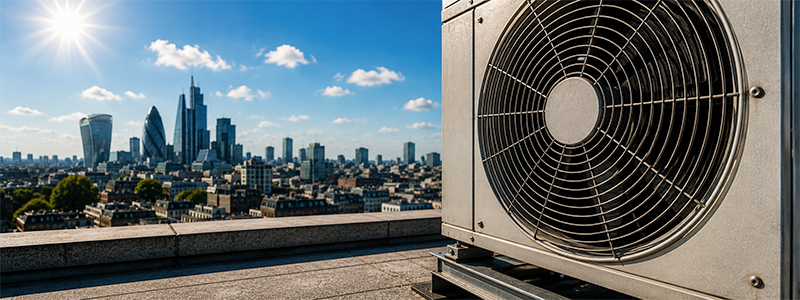
The UK recorded its highest-ever temperature of 40.3°C in July 2022 and based on recent years, heatwaves are no longer rare events. They are recurring operational challenges that facilities managers need to plan for. The real risk is not just occupant discomfort – when temperatures climb, HVAC and building systems come under significant pressure and failures that follow are expensive to fix and, in some cases, dangerous to ignore.
This article covers the ways heatwaves damage commercial HVAC and building systems, which assets are most vulnerable and the proactive steps that separate well-managed facilities from those left scrambling in the middle of a hot spell.
HVAC Systems: The First to Struggle
HVAC is the most immediate casualty of a heatwave. In most UK commercial buildings, air handling units and cooling systems were specified for a climate that rarely exceeded 28 to 30°C. When ambient temperatures climb well above that, systems are forced to run continuously at maximum capacity, a condition they were not built to sustain.
The consequences are predictable and costly:
- Compressor overload: Compressors are the heart of any cooling system. Sustained high ambient temperatures force them to work harder to reject heat, increasing electrical draw and generating excess heat internally. Overloaded compressors are the leading cause of HVAC failure during heatwaves.
- Refrigerant pressure spikes: High outdoor temperatures raise system pressures. If refrigerant levels are already slightly low due to minor leaks (common in older systems), pressure imbalances can trigger safety cut-outs, shutting the system down entirely.
- Filter blockages: Increased airflow demand accelerates the rate at which filters clog with particulates. Blocked filters reduce airflow efficiency and cause units to overheat.
- Condenser coil fouling: Outdoor condenser units rely on clean airflow to dissipate heat. Dust, debris and biological growth on coils reduce their efficiency, compounding the strain.
The Building Engineering Services Association (BESA) has highlighted that many UK buildings are operating HVAC systems that are simply not sized or maintained for the demands of modern summers. Research by Seppänen, Fisk and Lei-Gomez, published by Lawrence Berkeley National Laboratory, found that office productivity peaks at around 22°C and falls measurably above 23-24 °C – and at 30°C, performance is already 8.9% below its maximum. For a commercial office, that is not a comfort statistic; it is a performance metric with a direct cost.
Beyond HVAC: Other Systems at Risk
Electrical Infrastructure
Electrical systems generate heat as a by-product of normal operation. In hot weather, that heat has nowhere to go. Distribution boards, switchgear and UPS units all run hotter than their rated conditions when ambient temperatures are elevated, accelerating insulation degradation and increasing the risk of faults. Cable ratings are also temperature-dependent; a cable that operates safely at 20°C may exceed its thermal limit at 35°C under the same load.
Fire Detection and Suppression
Refrigeration and Cold Storage
How Planned Preventative Maintenance (PPM) Helps
A structured planned preventative maintenance programme ensures that electrical systems, fire detection, refrigeration and building fabric are all checked on a regular schedule, not just when something goes wrong. PPM reduces the likelihood of coincident failures, the scenario where the HVAC goes down at the same time as an electrical fault because both were overdue for inspection.
The value of PPM becomes particularly clear in summer. Pre-season HVAC servicing, carried out in spring before temperatures rise, gives engineers the opportunity to clean condenser coils, check refrigerant levels, inspect compressor health and replace filters. These are not complex interventions, but without them, a system that was borderline operational in April can become a liability by July.
The same logic applies across other building systems. Electrical thermographic surveys, carried out as part of a regular PPM schedule, identify hotspots in distribution boards and switchgear before they become faults. Fire system checks ensure that heat detectors are calibrated correctly and that suppression components are in good condition. Refrigeration units can be inspected for refrigerant integrity and condenser cleanliness before peak demand arrives.
Beyond individual asset health, PPM provides something reactive maintenance cannot: a documented service history. When a system does fail, engineers can diagnose faster and parts can be sourced more accurately when there is a clear record of what has been serviced, replaced and when. That translates directly into shorter downtime, which in a heatwave, is exactly what matters.
How Voltix Can Help
Voltix Services supports commercial properties with planned preventative maintenance, emergency repairs, HVAC servicing, electrical maintenance and fire and security systems. All work is carried out by directly employed engineers, meaning consistent quality and faster response times compared to contractor-dependent models.
Whether you need a pre-summer HVAC service, a full PPM programme, or a reliable emergency response partner, get in touch with the Voltix team to discuss how we can help protect your building systems before the next heatwave arrives.